3 Essays I Love With Vulnerability at the Center
Ahead of my class on how to be vulnerable in our writing, I’m sharing three essays I think of often that do this so well. Plus, the authors share why they think it’s important to be open in our work.

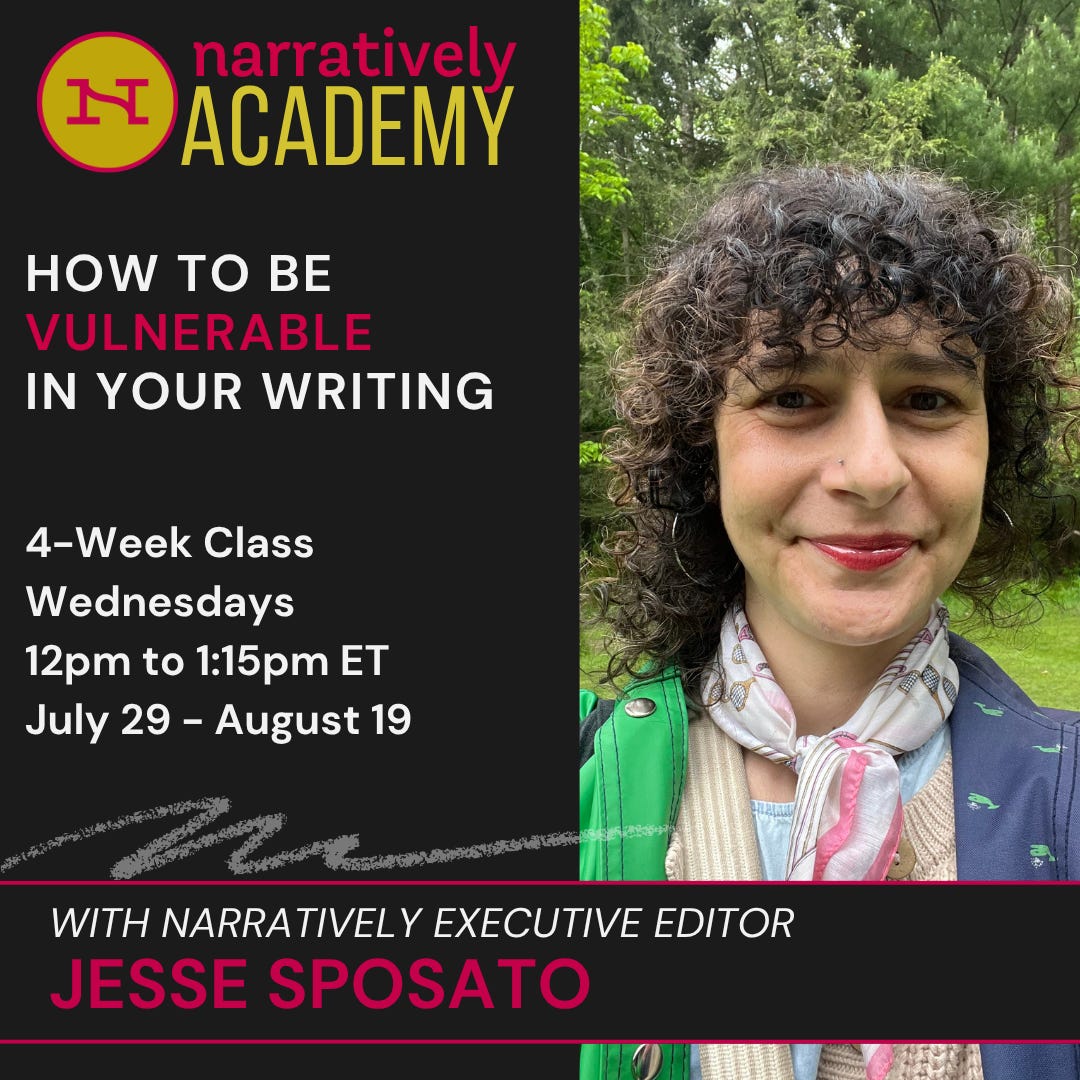
Beginning Wednesday, July 29, at Narratively Academy, our executive editor, Jesse Sposato, will be teaching a four-week class on How to Be Vulnerable in Your Writing. Today, Jesse shares some of her favorite essays that do exactly that.
P.S. And after you dig into this post, head over to our chat to share your #WeeklyWin — we want to hear about the writing goal you smashed this week, no matter the size!
I’ve been a sensitive over-feeler since forever — reading Jeanette Winterson books and analyzing Liz Phair lyrics in my teenage bedroom with the door closed, unknowingly mining these words for the vulnerability at their center. It’s the same quality I’m most drawn to in the memoirs and essays I read now, anything that makes me feel, makes me cry, makes me wonder, question, hope — deeply. Which is why the idea of teaching a class on how to be vulnerable in our writing — literally one of my favorite things to think about — was such a no-brainer. On that note, I wanted to share three essays that resonate for me in this way, and that I think about often. I also asked each of the writers behind these wonderful essays to share their thoughts on why vulnerability in writing is so important, and they were kind enough to agree. (Thank you again!)
My Long Journey to Bring My Daughter Home From Skid Row
After months of waiting for my runaway teen, Stephanie, to come back, I ventured into the grittiest part of San Francisco to search for her. What I found was more than I bargained for.
By Debra Gwartney

There are passages in this piece, first published in Creative Nonfiction, that make me catch my breath so quickly and so completely, I’m reminded of why the word breathtaking exists. This is one of them:
“All the sorting out we’ll do for the rest of our lives about who’s to blame doesn’t matter; my daughter ended up alone in an alley choking on her own drug-laced vomit, her 16-year-old heart giving out on her. How can I let that in? How can I think of it as a real part of my family’s life? It is, though, and the dark blessing is that it brought her home.”
There’s no pussyfooting around what’s happening here. Debra divulges her truth, forcing you to look at her words, at her circumstances, and bear witness. She brings you in, with such urgency and crispness. I can’t — and hope to never — know what it felt like to be Debra in this situation, but I can imagine it, thanks to her willingness to get so vulnerable, to bare it all on the page. I can get close enough to her pain to read this as both a triumph for the ages and also a cautionary tale. That Debra let me, let us, in on that, is a gift — I’m so grateful for it.
From Debra:
“Back when I started writing personal narrative, I instinctively pulled on the thread of vulnerability. Over the years I’ve paid more attention and have learned to plumb the moments of vulnerability in my work. One wise writer who helped me find my way was my husband, Barry Lopez, who said that there can be no intimacy on the page without first establishing vulnerability. That strikes me as utterly true. I think a lot about portals — about the doors I’m opening to let the reader into the experience I’m writing about. Vulnerability is a powerful portal because it’s the source of universality, and, ultimately, intimacy.”
I Was Drowning in My Marriage—An Impossible Crush Helped Save Me
It took seeing myself through someone else’s eyes to be able to realize my full potential and make the difficult choice I’d known I needed to make all along.
By Nikki Campo

I loved this one from the first moment I read it — when we were talking about commissioning it for the site — for so many reasons, among them its total honesty. In this essay, Nikki has to come to terms with a marriage she hoped she could make work, a crush she didn’t see coming and the truth about how she found herself in this predicament to begin with. Through her vulnerable writing, she’s fearlessly forthcoming about what she did and felt, even when it was confusing, even — especially — when it went against what she was expecting.
One of my favorite passages:
Then, a year and a half into our relationship, on a Valentine’s Day date that felt rife for a breakup, he proposed. From my side of the chocolate-smeared table in a chain ice cream shop, I stared at the square-cut diamond in platinum in the tiny red box, then at his smiling face. He would be so mad if I embarrassed him. Maybe we could be good again one day. I heard myself say yes. He carried me outside and twirled me around in the parking lot. Snow fell around us, and I shivered.
From Nikki:
“I think getting to vulnerability on the page requires digging one layer deeper into the ‘whys’ and ‘but hows’ than you want to. It’s writing what’s still a little emotionally messy; letting the parts that your first and second drafts tucked away find their way into font. And, to me, as a reader, there’s no greater pleasure than finding a little part of my secret-self splayed out on the page in someone else’s words, there for the deciphering, there for the seeing anew, and ultimately, there for the owning.”
I Was the World’s Worst Cancer Mom
The cancer ward (and my Insta feed) were filled with picture-perfect moms moving heaven and earth for their sick kids. Meanwhile, I spiraled into heavy drinking, depression and self-destruction.
By Elizabeth Austin

What a treat this one is. My colleague Brendan edited it, and when I first read it, I was straight-up jealous that he’d gotten to work on it! In it, Elizabeth admits all. She’s honest about the ways she showed up — and didn’t — when dealing with the devastating reality of her young daughter being sick. From the books she read to her in bed and the art projects she surprised her with, to the nights she resorted to drinking copious amounts of wine and chain-smoking at home alone while her daughter slept at the hospital.
A bone-chilling favorite passage:
The next morning I woke up alone in my bed. Seth had left sometime around 4 a.m., after I’d squeezed the last swallows of wine directly into my mouth from the plastic spigot. I laid in bed in the late morning light and thought about the clean white lines he’d cut on my coffee table — how I’d considered, then refused. I didn’t regret it. I didn’t want to get high. Highs were temporary. I wanted to go low. I wanted to crash through the bottom of whatever circle of hell we’d entered, and then I wanted to disappear.
From Elizabeth:
“When I’m vulnerable in my writing, I’m actually being gentle with myself — trusting that the things that scare me about the world and myself can still stand in the light. Vulnerability is a sign of humanity and trust, two things I think we need more of in the world, and so I strive to lead by example.”
Ready to Dive In?
In this analysis-meets-generative class, we are going to look head-on at how some of the most successful authors write vulnerably in their own work, how they talk about it, what it means to write vulnerably when others are involved and, what we’re so afraid of.
We will do this through close readings of several exceptional essays from some of the top writers of today and yesterday — from authors such as Roxane Gay, Brian Doyle, Kiese Laymon, Meredith Hall, Meghan Daum and more — as well as craft pieces and author interviews. In class, we will discuss and analyze our readings, and then to give our learnings a test-spin — and because we’re writers who like to write! — we will end each class with a generative writing exercise and optional share aloud.
This class will meet four times this summer, on Wednesdays, from 12-1:15 p.m. ET, starting July 29 and running through August 19.