

The Fine Art of Interrupting Your Routines
Sometimes the smallest perception shift can get your creativity back on track.
Next week we’re kicking off a brand new class, Finding Your Writing Rhythm with Josh Krigman, which is all about building skills to develop consistency and momentum in your writing practice. Today, Josh shares a little bit about how he thinks about writing routines.
I used to lead an after-school writing club for middle school students. Even though they’d all signed up because they liked to write, there were still some days (I’m sure you know them well) when it was hard to get them motivated. One time, on a day when no one was up to it, I led them through a theatre exercise I’d learned in college. I told them I was thinking of a story (I wasn’t) and had them ask yes/no questions about it. Whatever they asked, I answered ‘no’ to the first two questions and ‘yes’ to the third.
“Is it about kids?” “Nope.”
“Is there magic?” “No.”
“Does it happen in New York” “Yes!”
Soon they were all talking over each other, guessing where the story was heading. The entire mood had shifted. Instead of completing an assignment, they were playing a game.
A few years later I found the same game in Keith Johnstone’s Impro, a great book of improvisational theatre exercises that work just as well for your writing (or any creative practice). He talks about the panic most people feel when they’re asked to invent something from scratch and how reframing the approach can offer a way to arrive at the same results more comfortably.
That reframe can be a way to avoid feeling responsible for your own imagination (as it does with guessing the contents of someone else’s story) or it can be a way to add guidelines that make the blank page feel less intimidating and more like a game you’ve been invited to play. One of my favorite prompts, also from Impro, is one of those games.
“If I say ‘Make up a story’, then most people are paralysed. If I say ‘describe a routine and then interrupt it’, people see no problem.”
Describe a routine and then interrupt it. So simple! But also, I think, a prompt that leads to stranger and perhaps more interesting and organic stories than if you plotted one out the way we’re all taught to think we’re supposed to.
Routine: Dan always drives to work. Interruption: One morning he finds his car up on blocks and a flyer for an evangelical church wedged beneath his wiper.
Routine: Ellen is an artist who has only ever dated other artists. Interruption: Despite herself, Ellen realizes she’s falling in love with her downstairs neighbor, the tax attorney.
Routine: The horses at Big Hank’s Dude Ranch have always been friendly to visitors. Interruption: One Sunday morning, the horses decide they’ve had enough.
You can use this idea of interrupting a routine for a new scene, for a structure to a new story, or as a way to revise an existing project that’s gone stale. What are the routines you’ve already established? An action, a relationship dynamic, a way of life. A routine can be anything. So can the interruption.
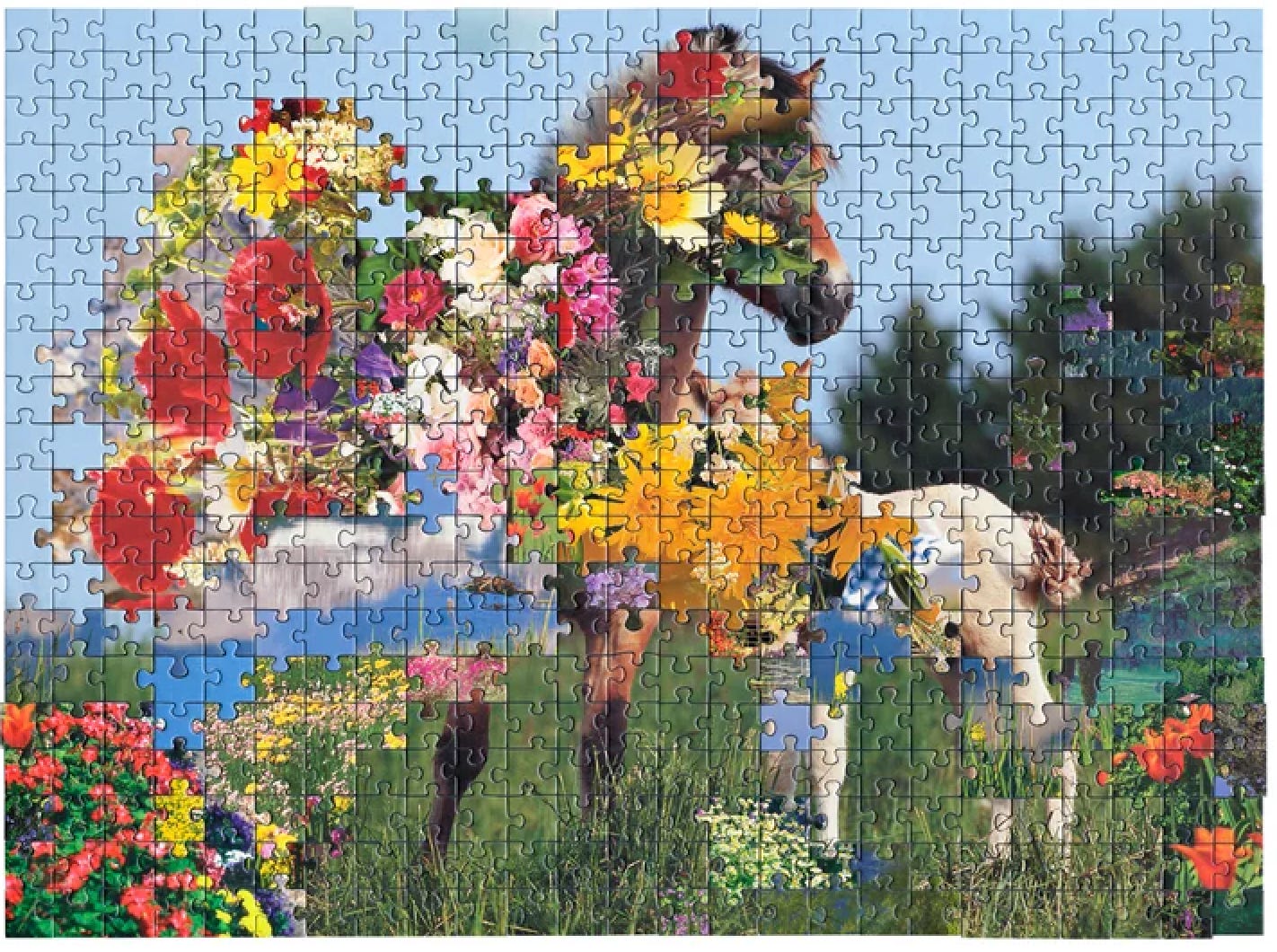
This idea applies to more than just narrative and performance. Kent Rogowski has a lovely and disorienting series where he combines different puzzle sets that have pieces with the same shape, turning two otherwise commonplace images — a horse, a bouquet of flowers — into something entirely new. The routine of looking at a horse is interrupted and we’re invited to experience it with fresh eyes.
Beyond these routines in our work, there are also the routines in how we make our work. Maybe you only try to write at a certain time of day, or in certain conditions. Or maybe you think writing is supposed to be hard, or serious, or labored over for hours at a time in silent isolation.
By noticing these routines, we give ourselves the opportunity to interrupt them, to shift our experience from completing an assignment to playing a game, and, in the process, make it all a little more fun.
Once you identify which routines work for you, you can use them to find your writing rhythm and build a sustainable, enjoyable practice.
Want to learn more? Josh’s upcoming “Finding Your Writing Rhythm” class is all about building a writing practice that actually sticks. Through structure, prompts, and accountability, you’ll develop a rhythm that works for your life—and keeps you moving forward, even when motivation dips. This is a great entry point if you’ve been trying (and not quite succeeding) to build a sustainable writing habit on your own.

I love the puzzle mash up! What a great idea!